
Author's details
- Hakim A Abubakre
- BA (Hons) International Business Management, Msc Digital Marketing.
Reviewer's details
- Dr. Khashau Eleburuike
- MBBS (Ilorin) MSc. Global Health Karolinska Institute.
- Resident doctor in family medicine in Northen Sweden.

- Date Published: 2025-09-07
- Date Updated: 2026-01-02
Diphtheria
Key Messages
- Diphtheria is a contagious bacterial infection that can be deadly if untreated.
- Vaccination is essential, as previous infection does not guarantee immunity.
- It is more common in areas with poor hygiene, crowding, and low vaccination coverage, especially in Sub-Saharan Africa.
- Early recognition and prompt medical care are crucial to prevent severe complications and death.
- Diphtheria is preventable and treatable. Routine vaccination, hygiene, and avoiding contact with infected individuals are key.
Introduction
What is Diphtheria?
Diphtheria is a contagious bacterial infection caused by Corynebacterium diphtheriae. It mainly affects the throat and nose (respiratory diphtheria) but can also affect the skin (cutaneous diphtheria), genitals, and occasionally other areas.
- The bacteria produce a toxin that can cause serious complications in the heart, nerves, kidneys, and blood.
- If untreated, diphtheria can block the airways, cause paralysis, or lead to death (death around ~10%).
- Previous infection does not guarantee immunity, so vaccination is essential.
Discussion
Why It Matters in Sub-Saharan Africa
- More common in areas with crowding, poor hygiene, and low vaccination coverage.
- Children are most affected, but unvaccinated adults are also at risk.
- Outbreaks can occur where healthcare access is limited.
Signs and Symptoms
Respiratory Diphtheria
- Sore throat, fever
- Thick grey or white coating on throat, tonsils, or nose
- Swollen lymph nodes, “bull-neck” appearance in severe cases
- Difficulty breathing or swallowing
- Watery or bloody nasal discharge
- Tiredness and weakness
Severe Complications
- Heart inflammation (myocarditis) → abnormal heart rate
- Nerve damage → weakness or paralysis
- Airway obstruction → life-threatening breathing problems
Cutaneous Diphtheria
- Skin sores or ulcers covered with grey membrane
- Redness or inflammation around the affected area
When to Seek Medical Attention
- Suspected diphtheria infection (sore throat, fever, grey membrane, skin lesions)
- Difficulty breathing or airway obstruction
- After direct contact with a confirmed case
- If travelling to areas with ongoing outbreaks
- Presence of complications: heart, nerve, or kidney problems
Prevention
- Vaccination:
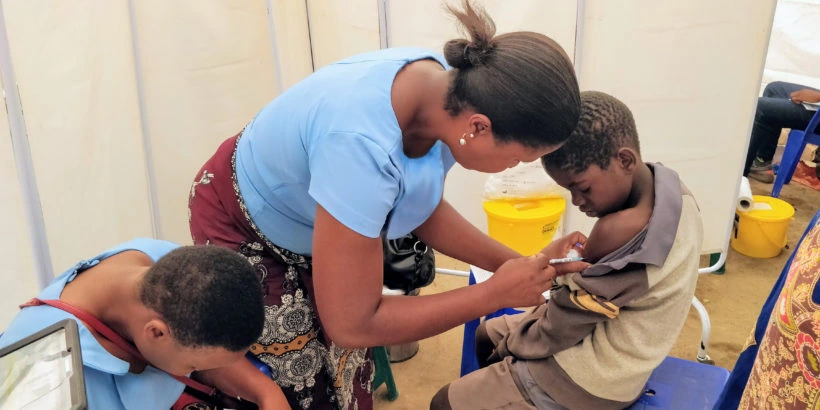
- Routine childhood vaccines (DTP or Pentavalent).
- Booster doses for adolescents and adults every 10 years.
- Hand hygiene: Wash hands with soap for 20 seconds or use alcohol-based sanitizer.
- Cover coughs and sneezes with tissue; dispose of tissue safely.
- Wound care: Cover cuts and sores.
- Avoid contact with infected individuals.
- Consult a doctor before travelling to areas with diphtheria risk.
- Antibiotic prophylaxis may be given to close contacts to prevent infection.
Conclusion
Diphtheria is preventable and treatable but can be deadly if not treated early. Vaccination, early recognition, and prompt medical care are crucial.
Related Topics
References
- World Health Organization (WHO). Diphtheria vaccine: WHO position paper. Wkly Epidemiol Rec. 2017;92(31):417–435.
- WHO. Pocket Book of Hospital Care for Children: Guidelines for the Management of Common Illnesses. 2nd ed. Geneva: WHO; 2013.
- Clarke KE et al. Diphtheria in Sub-Saharan Africa: Epidemiology and control challenges. Trop Med Int Health. 2022;27(2):106–116.
- Centers for Disease Control and Prevention (CDC). Diphtheria – For Healthcare Professionals. 2023.
- Cherry JD. Croup and Diphtheria in children. N Engl J Med. 2008;358(4):384–391.
Key Messages
- Diphtheria is a contagious bacterial infection that can be deadly if untreated.
- Vaccination is essential, as previous infection does not guarantee immunity.
- It is more common in areas with poor hygiene, crowding, and low vaccination coverage, especially in Sub-Saharan Africa.
- Early recognition and prompt medical care are crucial to prevent severe complications and death.
- Diphtheria is preventable and treatable. Routine vaccination, hygiene, and avoiding contact with infected individuals are key.