Author's details
- Dr. Khashau Eleburuike.
- MBBS (Ilorin) MSc. Global Health Karolinska Institute.
- Resident doctor in family medicine in Northern Sweden.
Reviewer's details
- Dr Eunice Ojoyi Onuh,
- MBBS, MSc, FWACS,
- Plastic and Reconstructive surgeon, National Hospital Abuja
- Date Published: 2025-12-28
- Date Updated: 2025-12-28
Burns Management in Sub-Saharan Africa
Key Messages
Take home messages
Burns can be life-threatening. Quick first aid, safe home care, and knowing when to go to hospital can save lives. Preventing burns at home is the best protection.
What is Burns?
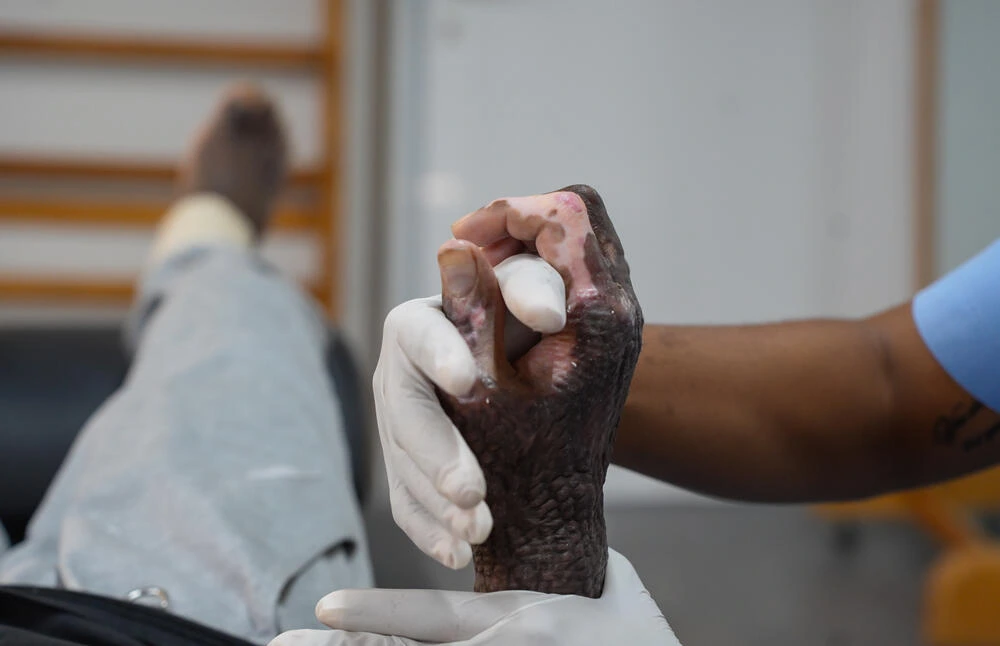
Burns is tissue destruction resulting from contact with heat (dry heat e.g. flame, fire, contact with hot surfaces; or moist heat such as hot water, hot oil or steam), electricity, chemicals, or radiation.
In sub-Saharan Africa, many burns happen in the home – especially to children – from open fires, kerosene stoves, lamps, or hot water.
Types of Burns
- Superficial (First Degree): Red, painful skin (like sunburn).
- Partial Thickness (Second Degree): Blisters, swelling, very painful.
- Full Thickness (Third Degree): White, brown, leathery or charred skin. It is not painful.
- Fourth Degree: Very severe, affecting muscle and bone.
WARNING SIGNS AND SYMPTOMS
- Red or peeling skin
- Painful blisters (may leak fluid)
- Swelling
- White or charred skin (serious)
- Loss of feeling or sensation in the burned area
Burns are major and life threatening if:
- They cover a large area; more than 15% of the total body surface area (TBSA) superficial partial thickness burns in an adult or 7.5% TBSA superficial partial thickness burns in a child. Full thickness burns are major when area burnt is more than 10% TBSA in an adult or 5% TBSA in a child.
- They affect face, hands, feet, genitals, or over joints
- They affect the airways (breathing difficulty after fire or smoke)
FIRST AID – What to Do Immediately after a burn injury
- STOP the burning process – move away from fire/heat, switch off electricity, roll on the floor if in a burning house
- COOL the burn – pour cool, clean water on the area for at least 20 minutes.
- PROTECT the burn – remove jewelry/clothing (if not stuck), cover loosely with a clean cloth or cling film.
- RELIEVE PAIN – give paracetamol or ibuprofen if available, keep person warm with a clean cloth or blanket and take to the hospital or call for help.
WHAT NOT TO DO
- Do NOT burst blisters.
- Do NOT apply kerosene, butter, oil, eggs, salt, honey or cow dung.
- Do NOT apply ice or very cold water over the burnt skin
- Do NOT peel off clothes stuck to the skin – cut around them instead.
SELF-CARE FOR MINOR BURNS
- Keep the burn clean; covered with non-stick and absorbent dressings.
- Change dressings regularly on alternate days
- Take pain medicines and elevate affected area if it is a limb
- Avoid spicy foods, alcohol, or smoking if burn is near mouth.
- Do not scratch healing skin; tap on it instead.
WHEN TO SEEK MEDICAL ATTENTION
Go to a clinic or hospital if:
- The burn affects a large surface area as stated above
- The burn is on the face, neck, hands, genitals, or joints
- You see pus, swelling, or foul smell
- You have high fever after the burn
- Blisters contain green or brown fluid
- There is difficulty breathing after fire or smoke
- The patient is a child, elderly person, or has other health problems
- The burn does not heal after 10–14 days of adequate care
PREVENTION OF BURNS
In the Kitchen:
- Keep children away from cooking stoves and hot liquids.
- Turn pot handles inward.
- Never leave cooking food unattended.
- Cooking place should be sited at a height above that of the child, away from passages
- Kitchen should be well ventilated; keep windows open
- Do not refill a burning lantern or cooking stove. Turn off and allow to cool before refilling with kerosene.
- Do not use Premium Motor Spirit (PMS) or adulterated kerosene to cook
- If clothes catch fire: STOP, DROP, and ROLL (or cover with a wet cloth).
In the Bathroom:
- Test water and ensure it is lukewarm before bathing children.
- Take cold water to hot water to mix before bathing, not the reverse.
- Do not keep hot water in the bathroom undiluted. One can slip and fall into the hot water. Leave hot water at cooking place.
- Keep water heaters below 49°C.
- Use non-slip mats and grab rails.
In the Bedroom:
- Do not smoke in bed or leave candles burning.
- Place candles over metallic surfaces; not wooden or plastic surfaces.
- Do not put hot water bottles directly on skin.
- Switch off electric blankets before sleeping.
General Safety:
- Store kerosene, petrol, and matches out of children’s reach.
- Cover open fires and lamps if possible.
- Teach children about fire safety.
Burns can be life-threatening. Quick first aid, safe home care, and knowing when to go to hospital can save lives. Preventing burns at home is the best protection.
Related Topics
- World Health Organization (WHO). Burn Prevention and Care. Fact Sheet, 2018.
- Forjuoh SN. Burns in low- and middle-income countries. Burns. 2006; 32(5):529–537.
- Ahuja RB, Bhattacharya S. Burns in the developing world and burn disasters. BMJ. 2004; 329:447–449.
- WHO. Pocket Book of Hospital Care for Children (2nd Edition). Geneva: WHO; 2013.
Key Messages
Take home messages
Burns can be life-threatening. Quick first aid, safe home care, and knowing when to go to hospital can save lives. Preventing burns at home is the best protection.