
Author's details
- Hakim A Abubakre
- BA (Hons) International Business Management, Msc Digital Marketing.
Reviewer's details
- Dr. Khashau Eleburuike
- MBBS (Ilorin) MSc. Global Health Karolinska Institute.
- Resident doctor in family medicine in Northen Sweden.
- Date Published: 2025-09-22
- Date Updated: 2026-04-01
Broken Bones(fractures) in adults
Key Messages
- Fractures are serious injuries that require prompt medical care.
- Common causes include falls, accidents, sports, and weak bones.
- First aid involves keeping the person calm, immobilizing the limb, and seeking hospital care immediately.
- Most fractures heal well with proper treatment, nutrition, and rest.
- Prevention includes safe living, road safety, and healthy habits.
Introduction
What is a fracture?
A fracture is a break or crack in a bone. It can happen to anyone, at any age. Fractures are common in adults and are usually caused by:
- Falls (slipping, falling from a height, or in older adults with weak bones)
- Road traffic accidents (especially motorcycles, bicycles, and cars)
- Sports injuries
- Workplace accidents (construction, farming, mining)
- Violence or assault
Sometimes, fractures can also occur because of:
- Osteoporosis (weak bones, common in older adults and post-menopausal women)
- Repetitive stress (for example, running long distances may cause stress fractures)
- Underlying diseases such as cancer, tuberculosis, or HIV that weaken bones
Discussion
Types of fractures
Doctors may describe fractures in different ways:
- Open (compound) fracture – bone pierces the skin. Higher risk of infection, needs urgent care.
- Closed fracture – bone is broken but skin is intact.
- Displaced fracture – broken pieces of bone are not aligned, often need surgery.
- Non-displaced fracture – bone breaks but stays in position.
By pattern (shape of break):
- Transverse / Oblique / Longitudinal – straight-line breaks.
- Comminuted – bone breaks into several pieces.
- Spiral – bone twists before breaking.
- Greenstick or Buckle – more common in younger bones but may be seen in adults.
- Stress fracture – small crack from repeated strain.
- Compression fracture – bone collapses, often in the spine.
By body part affected:
- Upper body: clavicle (collarbone), shoulder, arm, elbow, ribs, face, spine.
- Arms and wrists: Colles fracture (wrist), Smith fracture, scaphoid fracture, hand and finger fractures.
- Lower body: pelvis, hip, femur (thigh bone), knee, tibia and fibula (leg bones).
- Feet and ankles: metatarsal fractures, ankle fractures, calcaneal (heel), or talus fractures.
Warning signs and symptoms
- Severe pain at the site of injury
- Swelling and bruising
- Redness or skin turning blue/purple
- Area feels tender and painful to touch
- Limb looks bent, twisted, or shorter than the other side
- Trouble moving or putting weight on the limb
- Snapping or grinding sound at the time of injury
- In severe cases: bone sticking out through skin
First Aid and Self-Care
If you suspect a fracture:
- Keep the person calm and still.
- Immobilize the limb with a splint (stick, board, or cardboard) tied gently with cloth.
- Do not try to straighten the bone.
- Stop bleeding with a clean cloth.
- Apply a cold pack wrapped in a cloth for 15–20 minutes every few hours.
- Elevate the limb on pillows to reduce swelling.
- Do not eat or drink before hospital care (surgery may be needed).
- Go to the hospital immediately.
Home care after treatment:
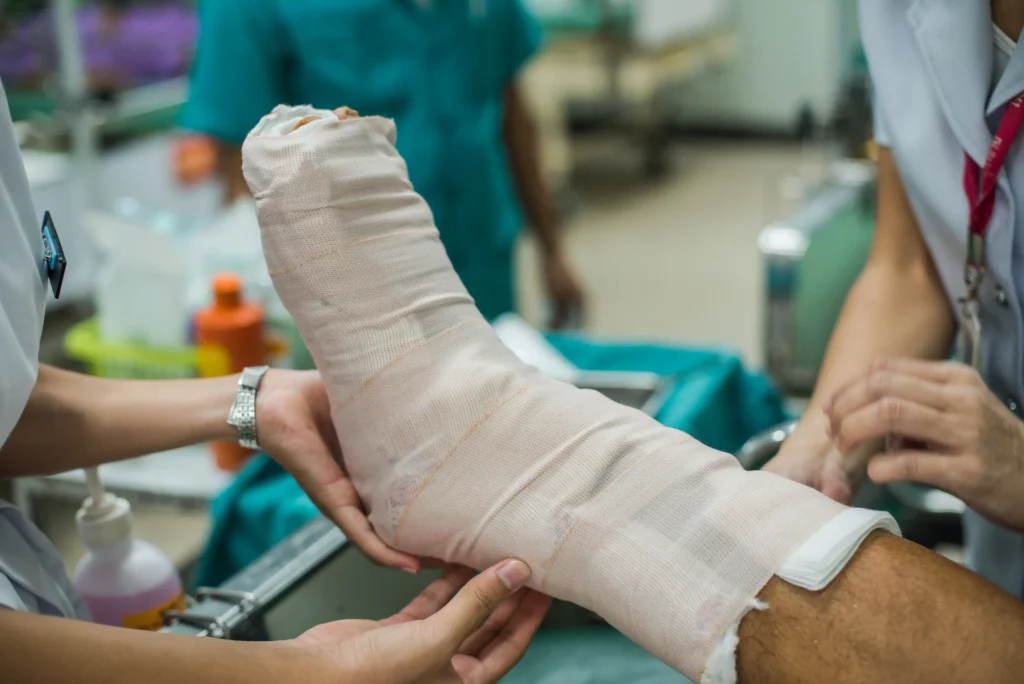
- Wear protective devices (splint, cast, boot, sling) as instructed.
- Do not put weight on the injured limb unless advised.
- Keep the cast dry and clean. Do not cut or insert objects inside it.
- For itching inside the cast, use a hair dryer on cool air — not sharp objects.
- Take pain medicines only as prescribed.
- Eat foods rich in calcium and vitamin D (milk, fish, eggs, beans, green leafy vegetables).
- Avoid smoking and excessive alcohol.
- Follow the doctor’s advice for exercises after initial healing.
- Use crutches or walking aids if recommended.
When seeking urgent medical attention
Go to a hospital immediately if:
- Bone is sticking out of the skin
- Limb looks bent, twisted, or much shorter
- Severe pain continues despite medicine
- Numbness or tingling (possible nerve injury)
- Limb becomes blue, cold, or loses sensation (poor blood supply)
- Rapid heartbeat, shallow breathing, or fainting (possible shock)
- Suspected fracture of the back, neck, pelvis, or hip
- Increasing swelling, pus, or foul smell (infection)
Treatment at the hospital
- X-ray or scans are done to confirm the fracture.
- Casts, splints, or braces keep the bone in place while healing.
- Surgery may be needed if bones are displaced or shattered.
- Pain medicines and sometimes antibiotics are given.
- Healing usually takes 6–12 weeks but may be longer depending on the bone and the patient’s health.
Prevention
- Eat a balanced diet with calcium and vitamin D.
- Exercise regularly – weight-bearing and balance exercises strengthen bones and prevent falls.
- Quit smoking and reduce alcohol, salt, and caffeine.
- Use seatbelts and helmets on the road.
- Remove tripping hazards at home, ensure good lighting, and use handrails.
- If you are a woman after menopause or a man over 70, ask your doctor about bone tests (for osteoporosis).
- Get regular vision and hearing checks to reduce fall risks.
Conclusion
- Fractures in adults are serious injuries that require medical care.
- Avoid traditional bone setters – they can cause infection, poor healing, or permanent disability.
- Most fractures heal well with hospital treatment, good nutrition, and proper rest.
- Prevention through safe living, road safety, and healthy habits is very important.
Related Topics
References
- World Health Organization (WHO). Violence, injuries and disability: prevention and management. Geneva: WHO; 2021.
- UNICEF. Road traffic injuries in sub-Saharan Africa: Facts and figures. UNICEF Africa Regional Office, 2020.
- Thanni LOA. Factors influencing treatment of fractures in the developing world: a review of the literature. Nigerian Medical Journal. 2017;58(4):123–128.
- Miclau T, et al. Challenges and opportunities for orthopaedic surgery care in sub-Saharan Africa. J Bone Joint Surg Am. 2020;102(12):1103-1112.
- National Institute of Arthritis and Musculoskeletal and Skin Diseases (NIAMS). Questions and Answers about Fractures. NIH, 2022., and simplified layout) for easy use in clinics and community health centers?
Key Messages
- Fractures are serious injuries that require prompt medical care.
- Common causes include falls, accidents, sports, and weak bones.
- First aid involves keeping the person calm, immobilizing the limb, and seeking hospital care immediately.
- Most fractures heal well with proper treatment, nutrition, and rest.
- Prevention includes safe living, road safety, and healthy habits.